
The Ahmed body is the benchmark that every automotive aerodynamicist knows. Its deceptively simple geometry — a blunt-nosed box with a 25° rear slant — produces the C-pillar vortex pair responsible for a significant portion of automotive drag. Getting it right in CFD is a rite of passage.
What normally takes an afternoon of manual meshing and dictionary tuning, AuraMesh reduces to a single command.
The Setup
Geometry: Standard Ahmed body (1.0 × 0.4 × 0.3 m) at 40 m/s freestream — Re ≈ 2.8 × 10⁶ based on body length.
AuraMesh automatically:
- Sizes the domain (3× upstream, 7× downstream, 6× lateral)
- Activates the ground plane
- Computes curvature-based surface refinement levels
- Adds a wake refinement box behind the body
- Generates
blockMeshDict,snappyHexMeshDict, andsurfaceFeatureExtractDict
Solver: simpleFoam with k-ω SST turbulence — the industry-standard RANS model for vehicle aerodynamics.
The Result
901,390 cells. Mesh OK. Converged in ~1,000 iterations.
Wake Structure — Velocity Centerplane
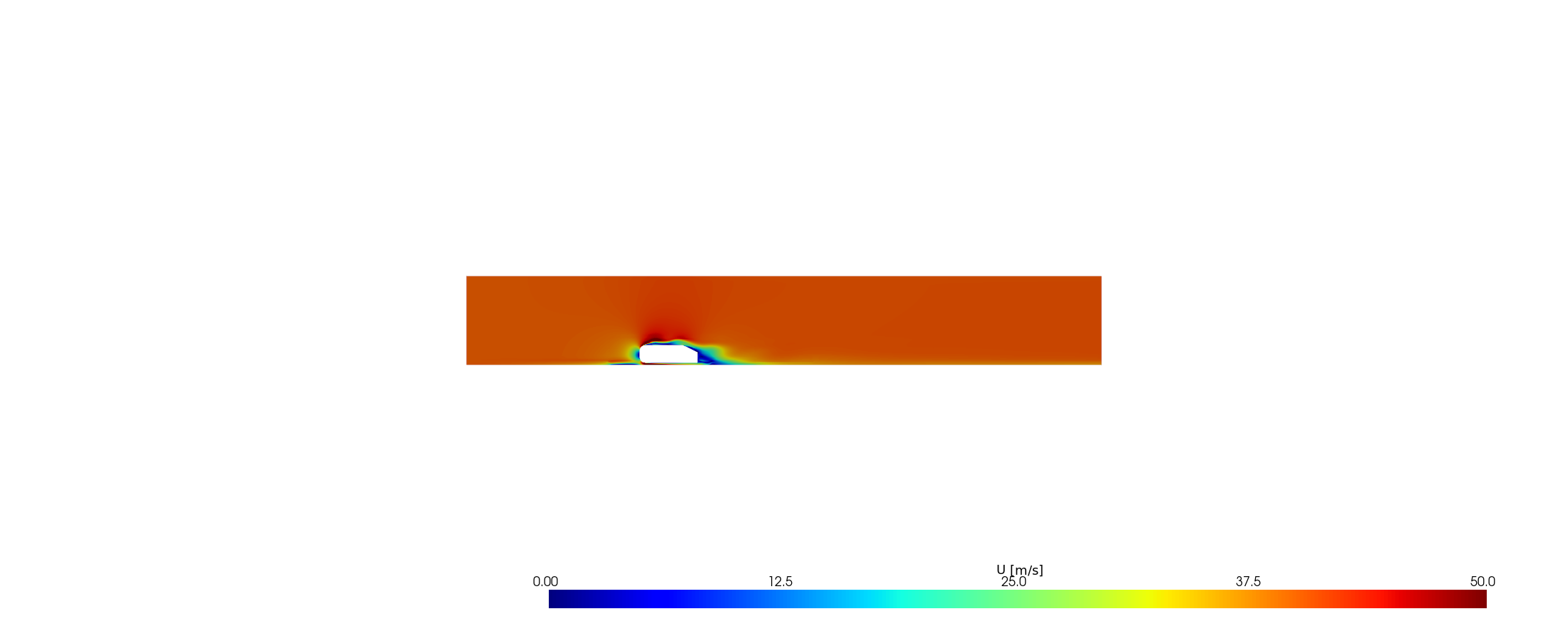
The vertical centerplane at y = 0 captures the essential physics: freestream acceleration over the roof, the separation bubble at the rear slant, and the extended recirculation zone behind the base. The velocity deficit in the wake is directly related to drag.
Vortex Structures — Q-Criterion
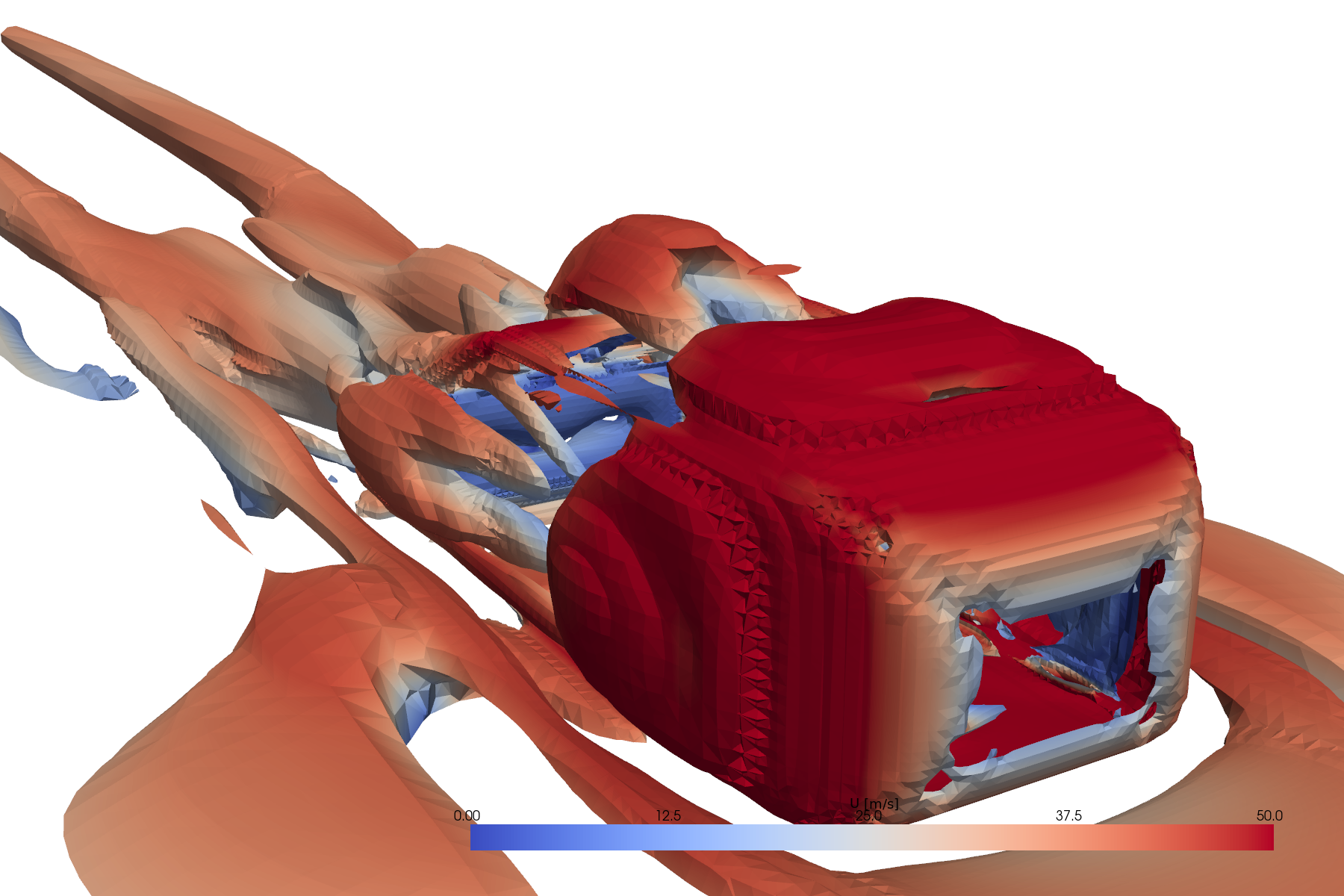
The Q-criterion iso-surface reveals the three-dimensional vortex topology: the C-pillar vortex pair rolling off the slant edges, the shear-layer instabilities at the slant trailing edge, and the base wake structures. These are the features that determine whether the Ahmed body is in the "high-drag" or "low-drag" regime (the transition occurs at 30° slant angle).
Surface Pressure — Cp Distribution
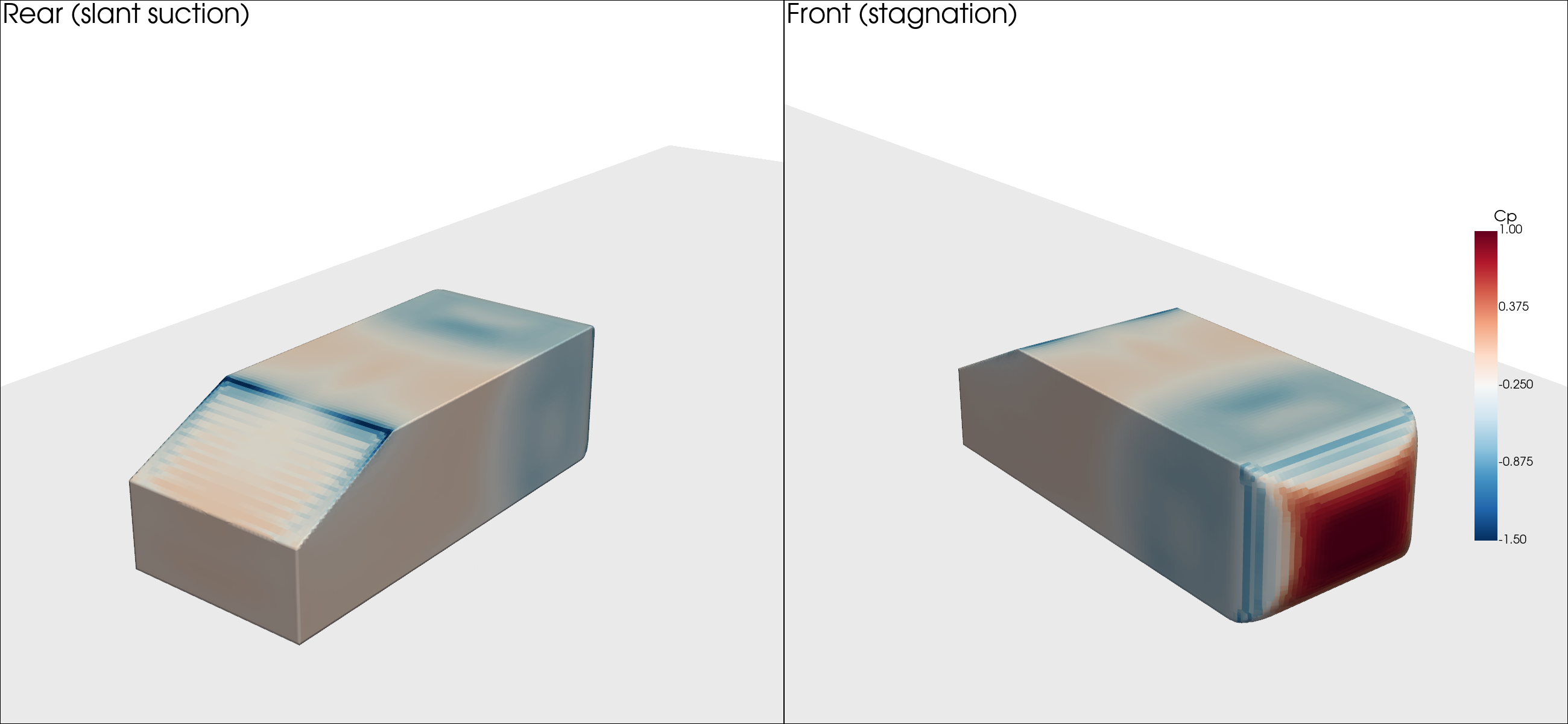
The Cp distribution on the body surface shows the stagnation region at the front face (Cp ≈ 1), the suction peaks at the roof leading edge, and — critically — the low-pressure zone on the rear slant that constitutes the majority of the pressure drag. The base (vertical rear face) also contributes via the recirculation-driven low pressure.
What This Demonstrates
| Aspect | What AuraMesh handles automatically |
|---|---|
| Domain sizing | Asymmetric box (short upstream, long wake), ground plane |
| Surface refinement | Curvature-driven levels (higher at edges, moderate on flat panels) |
| Wake resolution | Automatic wake box behind the body at an intermediate refinement level |
| Feature edges | Extracted and snapped at the appropriate level |
| Boundary layers | Computed from y⁺ target, applied on all wall patches |
The entire pipeline — geometry analysis, physics-based refinement, dictionary generation, meshing, and solving — requires no manual dictionary editing. The engineer's job is to interpret the results, not to babysit the setup.
Try It Yourself
AuraMesh is part of the SimuXAI platform. The Ahmed body case runs in under 2 hours on a standard workstation (8 cores) and produces publication-quality vortex visualizations from a raw STL input.
In this series: Ahmed Body Aerodynamics | Clean Room Airflow | Pedestrian Wind Comfort | Body-Fitted Pipe Meshing | Vortex Shedding Animation